Welcome to the first article in a series about winching operations.
The humble winch, arguably until recent years, probably one of the least utilised pieces of equipment on any operator’s rescue.
When I started my rescue journey back in the early 90’s, I found that it was common across all agencies to treat a rescue scene much like a game of golf, everything had to be played exactly where it lay. I found I was being taught the old mantra that any movement of a vehicle ‘would always’ compromise the patient in some way…usually bad. Any thought of using a winch (apart from a column pull or at a stretch conducting a reverse dash winch) was usually reserved for post patient extrication operations.
As road crash rescue techniques and extrication tools have evolved, driven by continuing changes in vehicle construction, along with advances in on-scene clinical treatment and care, combined with continuing education and sharing of knowledge, this old mantra of ‘no movement of the vehicle – ever!’, I find is changing to a more informed ‘no uncontrolled movement’. Rescue operators have understood and are now passing on to the next generation of rescuers that it’s okay to relocate a vehicle to gain better access while the patient is still inside, it’s okay to roll the vehicle with the patient and treating Paramedics inside it. Just make sure any movement is controlled, on our terms and communicated to everyone on scene.
The key words are controlled and communicated.
This change in approach to winching operations has seen a renewed focus on the effectiveness of these tools in providing rescuers with more options at an incident and we are seeing more winching evolutions being regularly conducted.
Let’s start this series of winching articles with the Controlled Rollover technique.
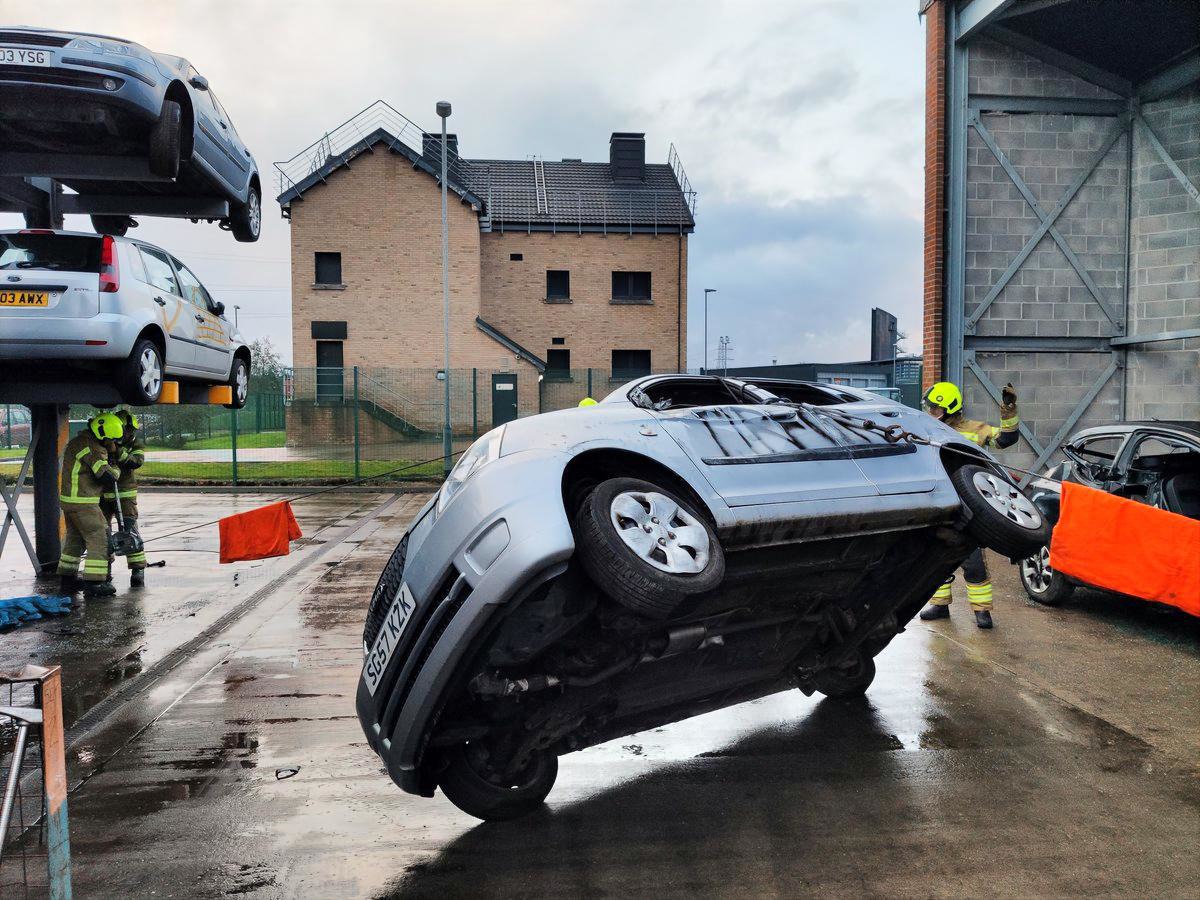
A controlled rollover is one of the vehicle relocation techniques used by rescue operators to deliberately and safely move a vehicle that has come to rest on either its side or roof. This technique involves the use of winches (Tirfor and or vehicle mounted) and tensioning devices (chain pullers/come alongs etc) to roll the vehicle in a controlled manner to provide rescue operators and medical personnel with better access to the vehicle’s occupants.
This technique is a carefully considered option, reserved for situations where standard extrication methods are not possible due to the vehicle’s position, structural integrity, occupants’ method of entrapment or terrain.
Why a controlled rollover may be necessary
-
- Complex or unusual position: The vehicle’s final resting position might impede rescuers from being able to safely or effectively operate hydraulic rescue tools (steep slopes, limited access due to obstacles e.g. trees etc).
- Reduced patient manipulation: In cases where a patient is found in an awkward position in a rolled vehicle, performing a controlled rollover can allow for a safer, more direct extrication, minimising further trauma.
- Improved access: Rolling the vehicle (in any direction) may provide rescuers and medical personnel with a better, clearer, unobstructed path to the patient to effect treatment and extrication. Improving the efficiency and effectiveness of the operation and hopefully achieving better outcomes for the patient.
The procedure for a controlled rollover
1. Scene assessment and initial stabilisation. Rescuers assess the scene for hazards such as fuel leaks, conduct initial stabilisation, and perform a risk assessment before proceeding. Patient care, including an initial medical assessment, is conducted simultaneously.
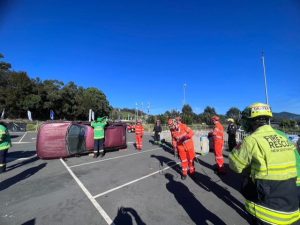
2.Anchoring and rigging. Two winches or a winch and tensioning device are typically used (it is usually easier to co-ordinate the speed and tension in the controlled rollover if rescuers have the luxury of using two of the same type of winch). The rigging is typically set up on opposite sides of the vehicle, often attached to the strongest structural points, such as the B-pillars (on steep slopes or where the vehicle has come to rest onto a tree or pole, rescue operators could consider using the tree or pole as a redirect – after carefully inspecting it for damage etc). Try to predict if your winch or chain puller has a long enough cable/chain to complete the roll in one go. If not, and you believe a reset will be required, ensure that the appropriate equipment is standing by (correctly rated ratchet straps or chains etc). Always remember that we must add an element before we subtract an element.
3. Tensioning. One winch is used to pull the vehicle onto its side, while the second acts as a counterweight to control the rate of the roll and prevent it from moving too quickly. We use just enough tension in the system to stop the vehicle from dropping from one winch onto the other as the vehicles load is transferred during the roll. The winches should not be fighting against each other and trying to pull the vehicle apart. This is a slow, smooth and deliberate operation. It is vital that the winching is coordinated effectively by a single person who can be seen by both winch operators (so they can respond to the verbal or visual commands) as well as see inside the vehicle and both winch lines at the same time (to observe and liaise with the vehicles occupants as well as monitor cable tension).
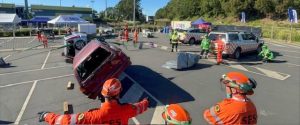
4. The roll. Rescuers operate the winches in a coordinated effort to slowly and carefully rotate the vehicle. The counter-tensioning winch ensures a controlled descent, allowing the vehicle to land softly in the desired position.
If a reset is required.
- Stop operations,
- Attach the temporary equipment (e.g. ratchet strap),
- Take up the slack on the temporary equipment (e.g. ratchet strap),
- Remove the winching equipment to be reset,
- Reset the winching equipment as required (extend chain puller etc)
- Re-attach the reset winching equipment
- Take up the slack on the reset winching equipment
- Remove the temporary equipment
- Continue operations
5. Re-stabilisation and extrication. Once the vehicle is in the desired position, rescuers will re-stabilise it and begin the extrication process to access the patient as required. This position offers more room to work and assists in minimising movement of the patient during extrication.
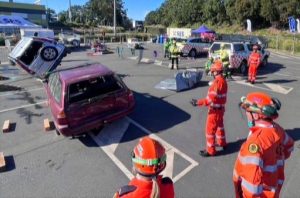 That’s it!
I’d encourage all rescue operators to practice winching evolutions during their regular drill/training sessions. It’s a handy skill to have and particularly be confident in if you should ever need it (a great tool to have stashed in your experience toolkit).
We’ll cover further winching operations in the next article with a focus on vehicle relocation/re-directs.
Stay safe.
Dean Scifleet
ARO RCR Research and Education Officer
0 Comments