
 of ideas and suggestions in relation to how rescue operators are to best deal with isolating and stabilising any type of Electric Vehicle (EV), either Fully Electric or Hybrid.
One of the major initial concerns and arguably one of the greatest risks to rescue operators is unexpected movement of a vehicle when working at an incident scene. When an EV is involved, this risk is potentially made greater to personnel in the immediate vicinity of the vehicle as there may be no visual or audible cues to indicate that the engine of the EV is still running.
Now, I’m sure people will state that a thorough and well communicated scene assessment will assist rescue operators in identifying all of the risks at the site, including that an EV is involved, and to a degree that is absolutely true, but we all know that due to the dynamic nature of vehicle incidents, that there are some circumstances (e.g. location of the vehicle, location of the patient/s, complex entrapment or other obstacles etc) where risks aren’t able to be identified or are unable to be mitigated in a timely manner. If this includes being unable to determine if an EV is running and in gear, an inadvertent touch on the accelerator pedal by the driver or rescue operators during the extrication – coupled with the incredible torque delivered by EV’s…… well, this could have life altering results.
So, how do we as rescue operators, safely and quickly disable an EV which has been involved in an incident, prevent unexpected movement of the vehicle and create a safer working environment for our crews?
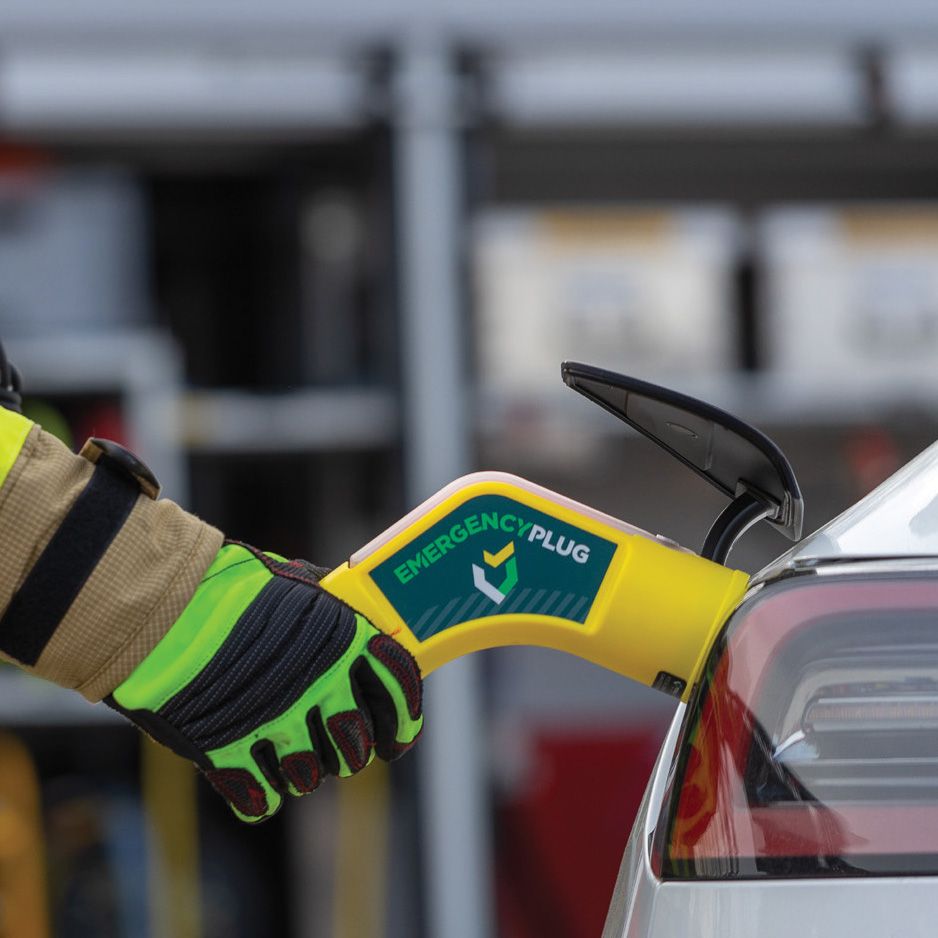
Enter the EV Emergency Plug.
PT Rescue are the exclusive distributor for the EV Emergency Plug in Australia and New Zealand and state that the ‘EV Emergency Plug is specially designed to be inserted into the vehicle charging point to disable the drive system and battery and allow safer access to the vehicle. The EV Emergency Plug is becoming regarded as a gamechanger in risk mitigation and prevention by emergency services and automotive groups throughout Australia and the world.’
The main advantages of the EV Emergency Plug are stated as:
- simple to use,
- quickly create a safe working environment,
- prevent unpredictable vehicle movement.

So, what is the EV Emergency Plug and how does it work?
The EV Emergency Plug site (emergency-plug.com) states that ‘The Emergency Plug has been developed to prevent unpredictable vehicle movement by any Full or Hybrid EV in an emergency situation as well as during regular maintenance.
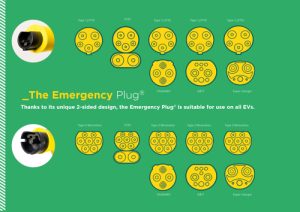
Even though every Emergency Plug requires different signals, our Emergency Plug simulates the different charging protocols of each EV, we are able to guarantee the Emergency Plug’s suitability for 100% of all EVs that comply with the safety protocols of the UN ECE R100 regulation (more on this below). By providing continuous visual feedback from the Emergency Plug about whether the EV is still able to drive away or not, we can ensure the safety of users throughout the emergency situation or during the entire maintenance procedure. Quickly creating and maintaining a safe working environment.
The EV Emergency Plug:
- prevents an EV from driving away under its own propulsion
- gives colour feedback indicating that the plug is working and has connection with the EV
- no contact with high voltage
- eliminates or significantly reduces the time spent in a dangerous working environment!
- universal, fits in every socket – worldwide
- can be plugged in and unplugged at any time
- all electric systems stay operational, such as windows, seats and lights
- for use in light cars, heavy trucks and buses
What is R100 regulation and what does it mean?
“If a battery can be externally charged by the user, vehicle movement by its own propulsion system shall be impossible as long as the connector of the external electric power supply is physically connected to the vehicle inlet”
The Automotive industry has developed several types of safety solutions in response to the R100 regulations. The Emergency Plug is capable of activating each safety protocol, ensuring the safety of first responders. Some EVs may activate their safety protocol when a standard charging plug is inserted. However, the user has no continuous visual confirmation of this. Moreover, this type of activation is mainly used in older EV types and is becoming less common.
In the sales brochure for the EV Emergency Plug there are several reasons listed as to why rescue operators should avoid using standard charging plugs in emergencies.
These reasons include:
- A standard charging plug doesn’t carry out a self-test so you can’t be certain that it isn’t damaged (the EV Emergency Plug conducts a self-test every time it is turned on so that operators can be sure that it is functioning correctly).
- The standard charging plug has no visual confirmation that it is working correctly, whereas the EV Emergency Plug uses different colours prominently displayed on the handle to inform the operator that it is working correctly.
- When using the EV Emergency Plug there is no risk of electrocution as it contacts the high voltage supply where the standard charging plug carries a higher risk of this occurring due to some EVs having a bio-directional charging option.
- It is not always possible to fit a standard charging plug into an EV when it is switched on due to the locking pins activating, this is not an issue with the EV Emergency Plug as it has no locking pins so that it can be inserted and removed at any time.
- The EV Emergency Plug is uniquely universal and will fit into all EVs, a standard charging plug will have limited application.
What’s in the kit?
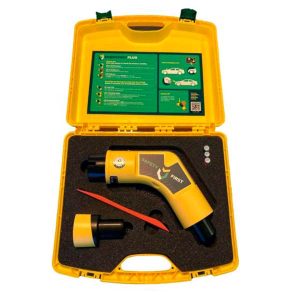
The EV Emergency Plug comes in a small hard case which includes:
- A fact sheet and reminder of the colour codes when operating the Emergency Plug (this is located inside the lid of the case for easy reference.
- EV Emergency Plug (2-sided design allowing universal fitment)
- 2 x small pry bars for forcing open the charging cover on the EV
- 3 x spare batteries
- Tesla Supercharger adaptor.
How do we use the EV Emergency Plug?
It appears to be a straight forward and fast procedure to get the EV Emergency Plug to work when on the scene of an incident. Ensure that the device has batteries in it, turn it on and the EV Emergency Plug will conduct a self-test function, this is indicated as it will flash red, green, blue and yellow as it checks that it is functioning correctly. Once the light changes to a flashing green, the self-test is complete and the EV Emergency Plug is ready for use.
 Open the charging port cover on the EV, some of these are push to open, others will require the use of the 2 small pry bars (supplied in the kit) to physically force the port cover open.
Select the appropriate end of the EV Emergency Plug to match the charging port and
insert.
When inserted, the light on the EV Emergency Plug should display a constant blue
light. This is a visual indicator to rescue operators that the EV Emergency Plug is
connected to the charging port and has good contact with the EV. The EV has now been placed into its charging safety mode in accordance with UN ECE R100 Regulation and can’t be moved under its own propulsion.
 What happens to the EV when the EV Emergency Plug is inserted into the charging port largely depends on the age and type of EV. Most EVs will put the transmission into Neutral or Park. Some EVs may also engage the handbrake.
Note: It is still recommended to chock the wheels and stabilise the vehicle as we would with any other vehicle involved in an incident as there is the possibility that the EV may roll away if positioned on sloping ground etc, it has only been made safe from moving under its own propulsion, but may still roll away.
There are several other modes of operation with visual indicators when using the EV Emergency Plug, these are:
- Flashing red light – Replace the batteries, turn on again and let the device conduct another self-test.
- Solid red light – the EV Emergency Plug has failed the self-test. No not use the EV Emergency Plug. Arrange for repair as per your organisations policy.
- Flashing yellow light – The EV Emergency Plug is not fully connected to the vehicle. The vehicle may not be completely immobilised. Check that the vehicle is not in ‘Drive’ mode.
- Flashing green light – The EV Emergency Plug is not connected to the vehicle. The connection to the vehicle may have been damaged (possible a cable from the charging port has been severely damaged). The vehicle is not immobilised.
With the popularity of EVs on the rise, both fully electric and hybrid, it is reasonable to assume that we will be called on to respond to incidents involving EVs more frequently. Our crews will be exposed to the risks of working at these incidents with increased frequency and we will continue to learn, develop and adapt. Passing on our knowledge and experience to assist in making our colleagues and communities as safe as we possibly can.
The integration of new equipment like the EV Emergency Plugs into rescue operations holds significant potential to improve safety and efficiency for our crews, and in that regard, it’s seriously got my attention. With that comes the understanding that we need to train our rescue operators appropriately to ensure that they fully develop the skills and knowledge in relation to the benefits and limitations of the EV Emergency Plug.
However, if I can make my crew safer and more efficient at an incident involving an EV and get rid of that nagging voice in the back of my head wondering if the vehicle is immobilised, then I’m looking at the EV Emergency Plug for that next layer of
protection.
In this article we have only focussed on preventing unexpected movement of an EV and thereby creating a safer working environment for our crews, we haven’t touched on a host of other issues when working around EVs or New Vehicle Design and its implications on patient access and crew safety etc, those will be topics of discussion for further articles in the future.
More information on the EV Emergency Plug:
PT Rescue – Emergency Plug
0 Comments