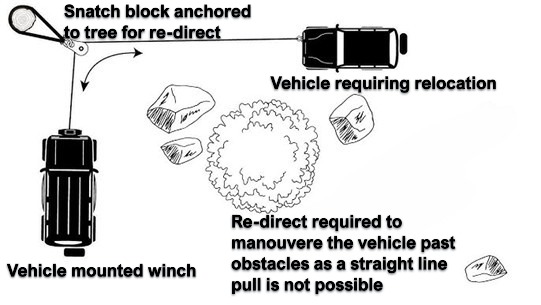
In a road crash rescue scenario, vehicle re-directs using a winch (it doesn’t matter if
it’s a vehicle mounted/powered winch or manually operated winch like a Tirfor)
requires the use of a snatch block to change the angle of a winch line to pull a
vehicle from a difficult position, such as being stuck against a tree, power pole, traffic
barriers etc, and provide rescue crews with more space to work in by moving the
vehicle away from any obstacles which may prevent access to the vehicle or patient.
In road crash rescue, winching re-direction involves using equipment like snatch
blocks (pulleys) and anchor points to change the angle of a pull when a direct,
straight-line pull is not possible or safe.
This technique can be particularly useful for stabilising or moving vehicles in complex
situations (e.g. where the vehicle has come to rest on a steep slope etc).
One point to emphasis in any winching operation, whether it is a simple straight-line
relocation pull, a re-direct or a controlled rollover is: Stabilise, Stabilise, Stabilise.
Always ensure that initial stabilisation has been conducted and the handbrake is
engaged prior to any winching being conducted.
Not adhering to the basics will almost always come back to bite us when we are
least expecting it (and always when there is a camera there to record our efforts).
The internet is full of videos of rescue crews, tow truck companies and 4WD
enthusiasts having a bad day when they forgot to engage a handbrake or place
wheel chocks for initial stabilisation. These videos usually result in a vehicle rolling
away when it is rolled back onto its wheels or re-directed across a slope. This is of
particular concern in a rescue scenario as we now have an arc of travel as the
vehicle pendulums to directly under the winch or re-direct point, along with the
hazard of the vehicle moving, there is also a tensioned cable moving with the vehicle
which could potentially strike and injure personnel within that arc of travel.
So please, lets do our best to look after everyone on scene and not end up starring in
a rescue horror clip of our own making, make sure all the little things are done well –
like engaging the handbrake before we winch.
Equipment:
- Snatch Blocks/Pulleys: These are the core of the re-direction process. They allow the winch line to be routed around obstacles or towards a more effective anchor point that isn't in a direct line of sight.
- Tree Saver Straps & Shackles: These are used to secure the snatch block or winch line to the anchor point. Never wrap the winch cable itself around a tree or hook it back onto itself, as this can damage the cable and the anchor. If you don’t have access to tree saver straps, use a folded tarp under the slings to help protect the tree from damage.
- Winch Extension Straps: Used if the primary anchor point is too far away.
How to perform a winch re-direct
- Safety First: The primary concern is safety. All non-essential personnel must be a safe distance away (1.5 to 2 times the length of the cable). Rescue operators should wear appropriate Personal Protective Equipment (PPE) and a winch damper (an open tarp, heavy blanket or jacket) must be placed over the tensioned line to absorb energy if it should break. Whilst it is not common for winch lines to break, it can happen, and when it does the cable kicks back violently with little to no warning. It is imperative that cable dampers are in place during winching operations.
- Anchor Point Selection: Anchor points must be strong enough to withstand the load. Healthy, large trees (using a tree-saver strap to prevent damage), pickets and ground plates (in the appropriate configuration for the estimated load) or other rescue vehicles are common choices.
1. Set up the pulley: Attach the snatch block or pulley to an appropriately
positioned and secure anchor point.
2. Run the winch line: Feed the winch line from the winch through the snatch
block.3. Re-anchor the line: Connect the end of the winch line to a new anchor point
on the vehicle to be relocated.
4. Begin winching: Using a slow and coordinated pull, the winch will now move
the vehicle drawing it towards the redirected anchor point creating more space
for rescuers to work in or move the vehicle past obstacles.
Benefits of using a winch re-direct
- Avoids further damage: Prevents further damage to the vehicle from scraping against any obstacles and reduces the impact on the environment (natural or constructed) by moving the vehicle in a safe, controlled and co- ordinated manner e.g. winching a vehicle out of a house.
- Increases pulling power: Adding mechanical advantage to the system (if you have sufficient snatch blocks) reduces the load on the winch, allowing it to move heavier loads.
- Improves efficiency: Of note in the case of vehicle mounted/powered winches a redirect assists in keeping the winch line centred on the drum of the winch, preventing it from binding (reducing winch efficiency by introducing friction) and reducing the risk of line damage and/or failure.
- Operation: All winching operations should be done slowly and with constant tension to prevent the cable from kinking or becoming tangled on the drum. If using a vehicle mounted winch the vehicle's engine should be running during winching operations to provide continuous power to the electrical system.
- Communication: Clear communication, often using hand signals or radios, is vital between the operator, a spotter, and anyone else involved.
That’s it for re-directs.
As always with rescue, there is a myriad of ways to approach a scenario and achieve a successful outcome. These articles are just meant to generate discussion and encourage crews to practice alternate methodologies for approaching an incident. I’m a big fan of the old ‘they who have the most tools in their toolbox of knowledge and experience, wins’.
Proper training and adherence to your agency’s recommended practices are essential to ensure the safety of all personnel and the successful extrication of the occupants from the vehicle.
Stay safe.
0 Comments