
I feel it would be safe to say that any operator who has been involved in the rescue field for the last 10 years or so has seen some major developments in vehicle design and construction as well as a significant change in the tools we use and how we use them during extrication operations. If you’ve been working in the industry like I have since the early 90’s (or for many even earlier), the changes in vehicles, tools and techniques are light years apart and that gap is getting larger by the day.
So, what are the major changes in relation to new vehicle design that rescue operators could reasonably expect to see on the road within the next few years and is the rescue industry keeping up with these advances?
Driven by research into customer wants and needs, most vehicle manufacturers and their design teams stated that when surveyed, the top five responses to what clients want from their vehicle in the future were: autonomous technology, connectivity, eco- friendly, advanced safety and personalisation/customisation.
It is not surprising then that advances in motor vehicle design are driven by development and research into alternative fuel sources, software integration,
autonomous systems, and the use of digital design tools. Many in the automotive industry believe that these advances will result in lighter, stronger, more efficient, and highly user customisable vehicles with new interior layouts and features.
Aimed at improving safety and enhancing the user experience, the key areas of advancement in vehicle design are listed below:
Alternate fuels and Sustainability:
- Alternative Powertrains: Development of electric vehicles (EVs), hydrogen fuel cells, and hybrid technologies.
- Lightweight Materials: Use of advanced materials like carbon fibre and aluminium to improve efficiency (lightweight and increased strength).
- Aerodynamic Design: Focus on sleeker designs to reduce drag and enhance energy efficiency.
Autonomous & Driver-Assistance Systems:
- Self-Driving Technology: Continued progress in developing fully autonomous vehicles.
- Enhancing safety: by integrating advanced driver-assistance systems (ADAS) like adaptive cruise control and lane-assist/lane departure which have become standard features in many new vehicles by integrating Artificial Intelligence (AI) and sensors to create safer vehicles and reduce the potential of human error.
Connectivity & Software plus Interior design:
- Connected Car Technologies: Use of real-time data for improved traffic management, navigation, and vehicle maintenance.
- Vehicle-to-Everything (V2X) Communication: Enables communication with infrastructure, other vehicles, and even pedestrians.
- Flexible Interiors: The absence of traditional engine components in many new vehicles (EVs etc) allows for innovative and customisable interior designs, creating space for work, entertainment, or living areas.
- Personalization: 3D printing and software-driven customisation are expected to make personalised design more accessible.
These advances, driven by customer needs, are making cars more technologically advanced, user-friendly and safer for the occupants, but what impacts are there on rescue operations?
Advances in modern motor vehicle design, and in particular, alternative fuel sources and the increased use of complex structural designs incorporating lightweight high strength steels can and have presented unique challenges to rescuers which have required teams to adapt the use of their existing tools, look to new technologies e.g. ANCAP Rescue App, develop new techniques and update their training in relation to new vehicles all with an aim to improve the outcomes for all involved
In this article the focus will be on the use of lightweight ultra-high strength materials, where is it and what concerns does it represent to rescue operators.
Lightweight high strength steels
High strength steel (HSS), Advanced High Strength Steel (HSS) and Ultra High Strength Steel (UHSS) and now also composite material elements are extensively
used in cars for increased crash safety and fuel efficiency by enabling lighter yet stronger vehicle bodies. These materials contribute to a more rigid safety cell for occupants, better crash energy management, and improved handling due to reduced body deflection. AHSS, UHSS and composite materials are key to meeting new, stringent safety standards while reducing vehicle weight and costs, making them a fundamental material in modern automotive design.
| Description and strengths of various steels (General) |
| Ultra High Strength Steel (UHSS) 950 – 1200 MPa |
| Advanced High Strength Steel (AHSS) 380 – 800 MPa |
| Very High Strength Steel (VHSS) 340 – 380 MPa |
| High Strength Steel (HSS) 340 MPa |
| Mild Steel less than 180 MPa |
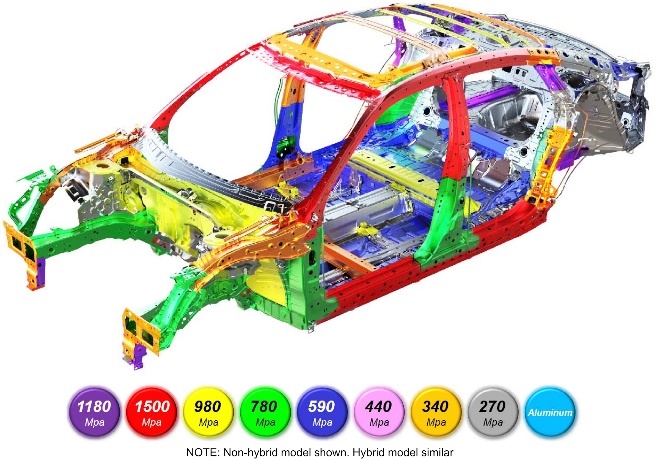
The safety cell or ‘H’ cell refers to the passenger compartment that is reinforced with lightweight ultra-high strength materials. These materials are placed strategically in areas subject to high energy loads in a collision. This is used to maintain a survival space for the vehicle occupants. (See image below)
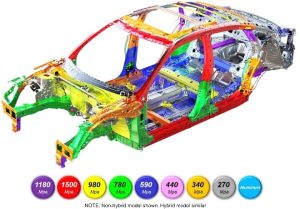
Image of a 2025 Honda Civic indicating the strength of the different structural elements
So, what does this mean for the rescue operator? Whilst lightweight high strength materials provide a rigid and robust design that is manufactured to more effectively manage impact energy to divert and dissipate energy away from the occupants it does have the potential to create some issues for rescue operators when attempting to release the occupants. Add to this new and more complex design elements in relation to the internal structure of a vehicle which now often includes multiple layers of UHSS/composite material and in the case of B Pillars an internal reinforcing rod, which can increase the complexity of operations to access and extricate a patient.
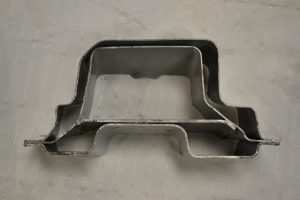
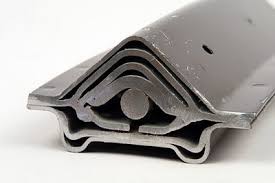
B Pillar Cross Section
Vehicle designed in the mid 90’s Modern vehicle design
One of the key changes many rescue operators are noticing with the new complex vehicle design and use of UHSS materials is that the UHSS isn’t cut, it fractures
during rescue operations, this presents safety issues to patients and rescue teams as the element being cut builds up kinetic energy during the cutting process. When the element, usually a B Pillar, is cut away from the rest of the pillar, the built-up kinetic energy can cause the cut piece of the pillar to fly off in any direction. It is because of this potential to eject across the vehicle it is strongly recommended that hard protection is in place before any cutting is commenced and even that the element to be cut is pinched/secured with spreaders or a Combi tool to prevent the element striking any personnel in the area.
Due to the changes in modern vehicle design and UHSS, many agencies/rescue teams have changed their approach in what would be considered ‘normal’ rescue techniques or evolutions. Many rescuers are now advocating for changes that see an increased use of rams or spreading operations for side removals, side rips etc (this will be the subject of another article in the future). Who would have thought that even 10 years ago? The changes in vehicle technology have driven changes in how we, as rescue operators, must perform at an incident. That’s not to say that cutting operations are a thing of days gone by, it’s probably a more reasoned approach now.
Indeed, tools like the ANCAP Rescue App, are particularly important when it comes to modern vehicles. All the information a rescuer needs in relation to a vehicle (battery location, how to shut the vehicle down, airbag and pre-tensioner locations, structural elements and recommended cutting points) are all at the rescuer’s fingertips. Tools like this are gamechangers and part of the new way rescuers are operating more effectively and efficiently at the scene of an incident.
In short, the new vehicle design and lightweight materials have the potential to significantly improve occupant safety in the event of an incident, these same features can hinder rescuers during the extrication process.
Stay safe.
0 Comments