- 26% of children and adolescents aged 2-17 were living with overweight or
obesity. - 66% of adults aged 18 and over are living with overweight or obesity.
For us as rescue operators, this increase in population with higher bodyweight or mass means that there is an increasing possibility that you will be confronted with a rescue incident involving a larger patient and my question to you is, do you feel ready to take on this incident? Have you trained and prepared for the unique needs of larger patients whether it be a road crash rescue, industrial and/or domestic rescue, USAR or vertical rescue scenario?
The data above shows that the potential larger patient is statistically represented by over two thirds of our population and I’m not entirely sure that we are training and preparing our people/teams appropriately for incidents involving them but simply adapting what we already train for and use our combined experience to get the job done.
I prefer to use the term ‘Larger patient’ in these scenarios as the terms Obese or Bariatric may not necessarily fit the true description of the patient. A quick search on the internet found definitions of these 2 conditions as follows:
- Obese: excessive fat accumulation that poses a health risk, most commonly measured by a Body Mass Index (BMI) of 30 or higher.
- Bariatric: an individual with health limitations due to severe obesity with a BMI over 35 or a BMI over 30 with serious co-morbidities (e.g. diabetes, heart disease)
The NSW Government published a Guideline document in March 2024 ‘Management of Patients with Bariatric Needs’ which defines bariatric patients as follows:
- For the purpose of this Guideline is an in or outpatient (Child or Adult) with
bariatric needs (over 120kg or BMI >30) receiving healthcare by NSW Health workers in transport, facility, at home or in the community. Bariatric is an internationally accepted term applied to patients with a Body Mass Index (BMI) exceeding a range where body size restricts mobility, health or access to available services and equipment.
The reason I raise this is, I am not worried about trying to calculate a patients BMI on the side of the road but I am concerned with knowing any additional health problems (if relevant) and I’ll do a best guess estimation of their weight (if they can’t provide me with that information) so that I can work out how many personnel will be required to lift them when necessary. I’ve also attended an incident where a young heavyweight powerlifter was involved in an MVA, from memory he was around 140 kilograms. He would’ve easily exceeded a 35BMI but was young, fit and healthy – certainly not a bariatric patient. I think you see where I’m going with this and this is why I prefer to say larger patient, plus I feel it’s a little more empathetic for the patient to hear that rather than obese, morbidly obese or bariatric. Handling larger patients in the road crash rescue environment requires specific training, extra personnel, and potentially additional equipment to manage the unique challenges posed by patients’ size and weight.
The key focus for me with this type of incident revolves around a focus on the safety of the rescue operators, safe patient handling, the patients’ needs, using specialised equipment (if available), and any extra work required to increase the size of the extrication pathway to ensuring the safety of both the patient and the rescuers.
Challenges in Extrication
- Physiological differences: Larger patients may have decreased lung capacity and increased airway resistance, which can be worsened by supine (flat on the back) positioning.
- Equipment limitations: Standard rescue equipment, including stretchers, rescue boards and lifting devices, may not have sufficient weight capacity or width. The patient may exceed the Safe Working Load of available equipment.
- Access difficulties: Narrow vehicle spaces and the patient’s body mass may make traditional extrication manoeuvres difficult; this may result in additional work by rescuers to increase the size of the extrication pathway for the patient and the rescue operators to manoeuvre/move through.
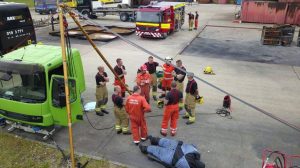
Outreach Rescue Training – Bariatric Rescue Course using an Artificial High Directional (AHD) and Mechanical Advantage (MA) system to lift a larger patient out of a truck.
- Manual handling risks: Rescuers face a high risk of musculoskeletal injuries, especially back injuries, when moving large patients without proper tools or sufficient help. If possible, wait for additional assistance to arrive to assist with a larger patient lift.
- Dignity and empathy: The rescue operation should be conducted with compassion and empathy, addressing the patient’s physical and emotional needs.
Specialised Techniques and Best Practice
- Incident Command and Scene Assessment: The Incident Commander (IC) must be notified immediately if a larger patient is involved. The IC can then deploy the necessary resources, such as additional personnel or if available, specialised heavy lifting equipment.
- Multi-Agency Planning: Communication and planning between all emergency services is crucial to coordinate the rescue effort and ensure a seamless transition of care and transport.
Positioning and Airway Management:
- Conscious patients should be positioned to facilitate lung expansion, which may involve "ramping" them (using pillows or blankets to elevate their head, shoulders, and torso).
- Manual spinal stabilisation is maintained throughout the process.
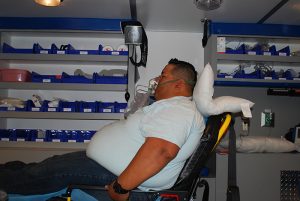
An image of ‘ramping’ a larger patient.
Vehicle Modification (Extrication):
- Standard road crash rescue techniques for creating space, such as roof flaps, door or side removals may need to be adapted or combined with other methods to create the additional wider space required to safely manipulate the patient.
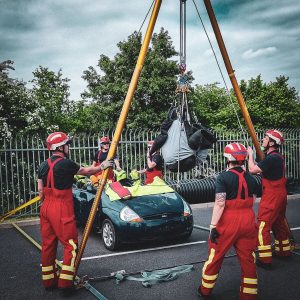
Outreach rescue training – Paratech Heavy Lift Course, using an AHD and MA to lift
a larger patient. The patient was lifted and then the vehicle rolled back allowing the patient to be lowered directly onto the gurney.
- Consider reducing the distance the patient must be moved or carried
before being placed on a gurney.
Use of Specialised Lifting Aids:
- Bariatric moving tarps/sheets: These are a primary tool, often having high weight capacities (up to 600kg) and multiple grab-handles to allow additional rescuers to lift safely using proper lifting techniques (bending knees, keeping back straight).
- Bariatric stretchers/gurneys: These provide increased width and higher weight limits for moving and transport.
- Air-lifting systems: In some situations, specialised air-lifting bags can be used to raise the patient to a transport device or “drag” them down stairs.
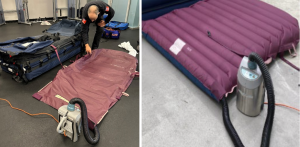
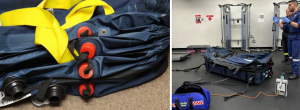 The Hover Jack (left) is an inflatable lifting system in use by NSW Ambulance that
can lift patients to a height where they can be easily slid onto a Gurney. The hover
Jack can also be used to drag larger patients through tight internal spaces and doorways.
The Hover Matt (above) also in use with NSW Ambulance and can be used to move the patient from the ground onto the Hover Jack or used to drag the patient.
- Additional Personnel: Always call for extra personnel. Having sufficient personnel at the site is critical to safely manage the weight and manoeuvre the patient and equipment, reducing the risk of injury to the patient and rescue
operators. - Logistics and Transport: Pre-plan the path of extrication, considering obstacles like narrow doorways or terrain, and ensure the receiving Ambulance or facility has the appropriate transport capabilities and equipment (e.g. bariatric Ambulance).
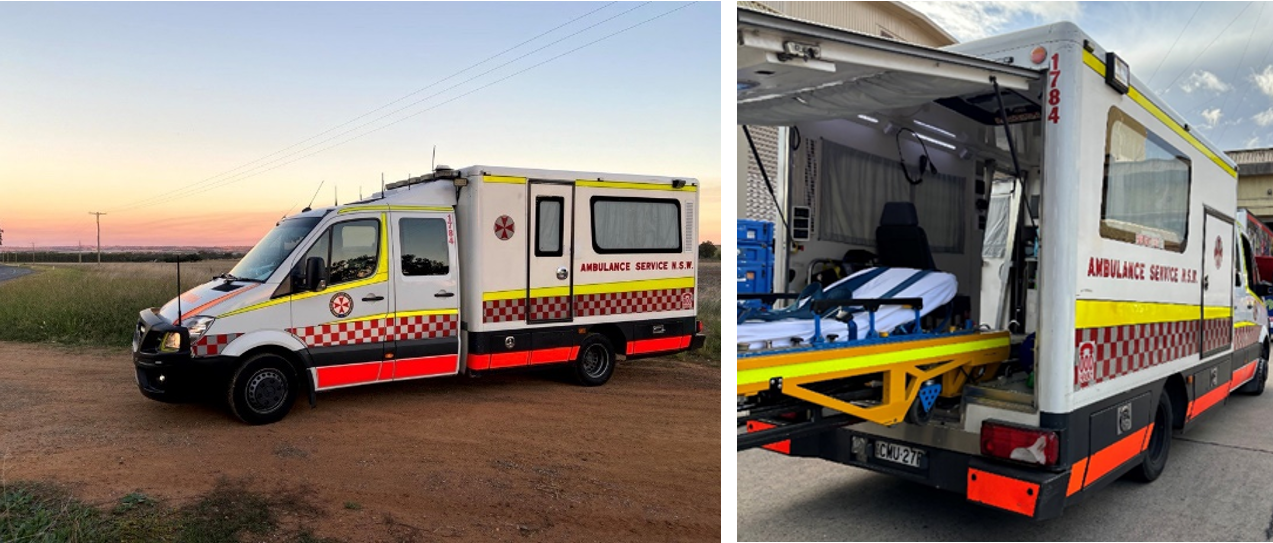
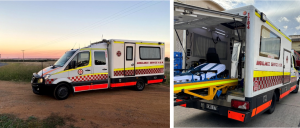 NSW Ambulance Multi-Purpose Vehicle is designed to transport larger patients.
Using specially designed hydraulically operated wider stretchers to meet the needs
of larger patients.
Be Prepared
As always, train for the unexpected. Use your teams training sessions effectively, see if your agency has access to bariatric training dummies to help your team work on solutions in creating space and manipulating the patient. See your local Paramedics and arrange some combined training sessions around managing larger patients and find out what equipment they have and train together on how to use it, develop the inter-service relationships to assist your communities. If we always train on the same things the same way, we’ll always do what we’ve done in the past. Mix things up, prep a training session for a larger patient and challenge your rescue operators. It could be interesting to see what they come up with for solutions.
Preparation and communication are key to any type of rescue event and these activities will certainly assist in developing skills, knowledge and relationships between the services in your community.
Stay safe.
0 Comments